http://www.jillanholt.ca/
Category: Architecture Design
Susane Seitinger’s research
- The researcher’s main page
- LightBridge, May 2011
- (in Video(youtube), around 4min, she describes the system and mentioned opensource SW to support media facade programming)
- Liberated pixels :alternative narratives for lighting future cities, 2010
- PhD Dissertation
- Light Bodies
- Susane Seitingerの博士での研究のプロジェクト3つのうちの一つが、ランタン(日本でいえば、夜間の外出時にもちあるいた手持ち提灯)の歴史をふまえた個人用の、センサーによって与えられた刺激に反応する光のオブジェクトでした。クラシックのコンサートやジャズバーで複数を置いて場所の演出に利用した例が論文で示されています。Seitingerの研究のポイントの一つが、既存のインフラから光を自由にするための技術なのですが、ガス灯という形で社会インフラになる前の、個人が小型のランタンを持ち、または玄関前に自分で設置し、管理していた光の集合しかなかった時代の光のありかた
- Urban Pixels
- Here (MIT Labcast)she explains basic concept of ‘Urban Pixels’ together with her adviser William Michael
- Light Body
- in Shigeru Kobayashi’s ‘Prototyping Lab’, pp20
- we asked how we might engage people in more actively shaping the lightscapes which surround them.
Live Color Wall Project,by Semi Transparent Design, Sony Building, Ginza, Tokyo, 2007
from Kobayashi-san, May 6th, 2011
Sentient City, Mark Shepard(ed), 2011
Definition of Sentient City by Mark Shepard
“dataclouds of 21st century urban space” that shape the experience of those in it.
Book
- Introduction: Mark Shepard
- Toward the sentient city: Mark Shepard
- Systems, Objectified: Hadas Steiner
- Case Studies
- New Interaction Partners for environmental governance:
- Amphibious Architecture:
- David Benjamin and Soo-in Yang (The Living) and Natalie Jaremijenko (xDesign Environmental Health Clinic)
- Structuring Participation for an Energy Commons
- Natural Fuse:
- Usman Haque, Nitipak ‘Dot’ Samsen, Ai Hasegawa (Haque Design+Research)
- Urban Digestive Systems
- Trash Track:
- MIT SENSEable City Lab
- An International Failure for the Near Future
- Too Smart City:
- David Jimison and JooYoun Paek
- Situating Knowledge Work in Contemporary Public Spaces
- Breakout!: Escape from the Office:
- Anthony Townsend, Antonina Simeti, Dana Spiegal, Laura Forlano, and Tony Bacigalupo
- Essays
- The Action is the Form: Keller Eastering
- Interaction Anxieties: Omar Kahn
- New Spatial Intelligence, or the Tree allowed to grow freely, but to man’s pattern: Dan Hill
- Boxes Towards Bananas: Dispersal, Intelligence and Animal Structures: Matthew Fuller
- Unsettling Topographic Representation: Saskia Sassen
- The Urban Culture of Sentient Cities: From an Internet of Things to a Public Sphere of Things: Martijn de Waal
- http://www.smartplanet.com/blog/smart-takes/in-a-sentient-city-what-is-public-or-private/16343
- Space, Finance, and New Technologies: Kazys Varnelis
- Your Mobility for Sale: Trebor Scholz
- Comforts, Crisis, and the Rise of DIY Urbanism: Mimi Zeiger
- 8. Matthew Passmore, “Participatory Urbanism: Taking Action by Taking Space”, SPUR Urbanist, Feb 2010.
- 10. Clay Shirky, “Cognitive Surplus: Creativity and Generosity in a Connected Age”, Penguin Press, New York 2010.
- 13. http://www.weeels.org/faq.html#is-it-safe-to-get-into-a-car-with-a-stranger
- Toward the Sentient City: Expecting the Extensible and Transmissible City: Anne Galloway
- Postscript: Notes on Survival in the Sentient City: Mark Shepard
Exhibition
Blog article
http://www.cityofsound.com/blog/2009/10/toward-the-sentient-city.html
Liberated Pixels: Alternative Narratives for Lighting Future Cities,Susanne Seitinger, PhD Thesis, 2010
View more presentations from susanne2009
- Liberated pixels : alternative narratives for lighting future cities (Read only PDF)
- http://susanne.media.mit.edu/node/34
- Citable URI: http://hdl.handle.net/1721.1/61935
- Abstract
- Lighting and illuminated displays shape our relations to urban environments and to one another at night and increasingly during the day by transforming what Kevin Lynch referred to as the “image of the city” (1964). Today, the wide-spread availability of LEDs (light-emitting diodes) in combination with embedded, miniaturized computation offer different ways of designing ambient infrastructures. In this dissertation, I explore these alternatives to exploit the programmable and responsive capabilities of LED-based, low-resolution systems. In short, I examine the alternative aesthetic and communications opportunities afforded by a new generation of lighting and display technologies in the city.I investigate the origins of lighting and displays to illustrate how they have evolved through a complex interleaving of the social and the material. This grounding leads me to develop three design explorations that focus on addressability, mobility and programmability. The first of these explorations, Urban Pixels, presents a wireless network of individual, autonomous physical pixels that can be deployed on any surface in the city. The second, Light Bodies, reconnects with the history of lights-on-people like lanterns that travel through the city with their users. The third, augmented-reality street lighting, provides a layer of programmability for existing infrastructural networks.
Together the historical perspective and design interventions lead to a performative framework of what I call “liberated pixels”, a new generation of lighting and display technologies. Liberated pixels can be placed flexibly within any context and recruited in different situations for aesthetic and ambient information purposes. This vision captures the contingent and emergent nature of “sociomaterial assemblages” (Suchman 2007) to chart holistic technical, aesthetic, and social directions for future infrastructures of “imageability” (Lynch 1964) in the city.
Media Architecture Biennale, 2010
http://www.mediaarchitecture.org/biennale2010/
Live Color Wall Project, by Semi Transparent Design, Ginza, Tokyo, 2007
from kobayashi-san, May 6th,2011
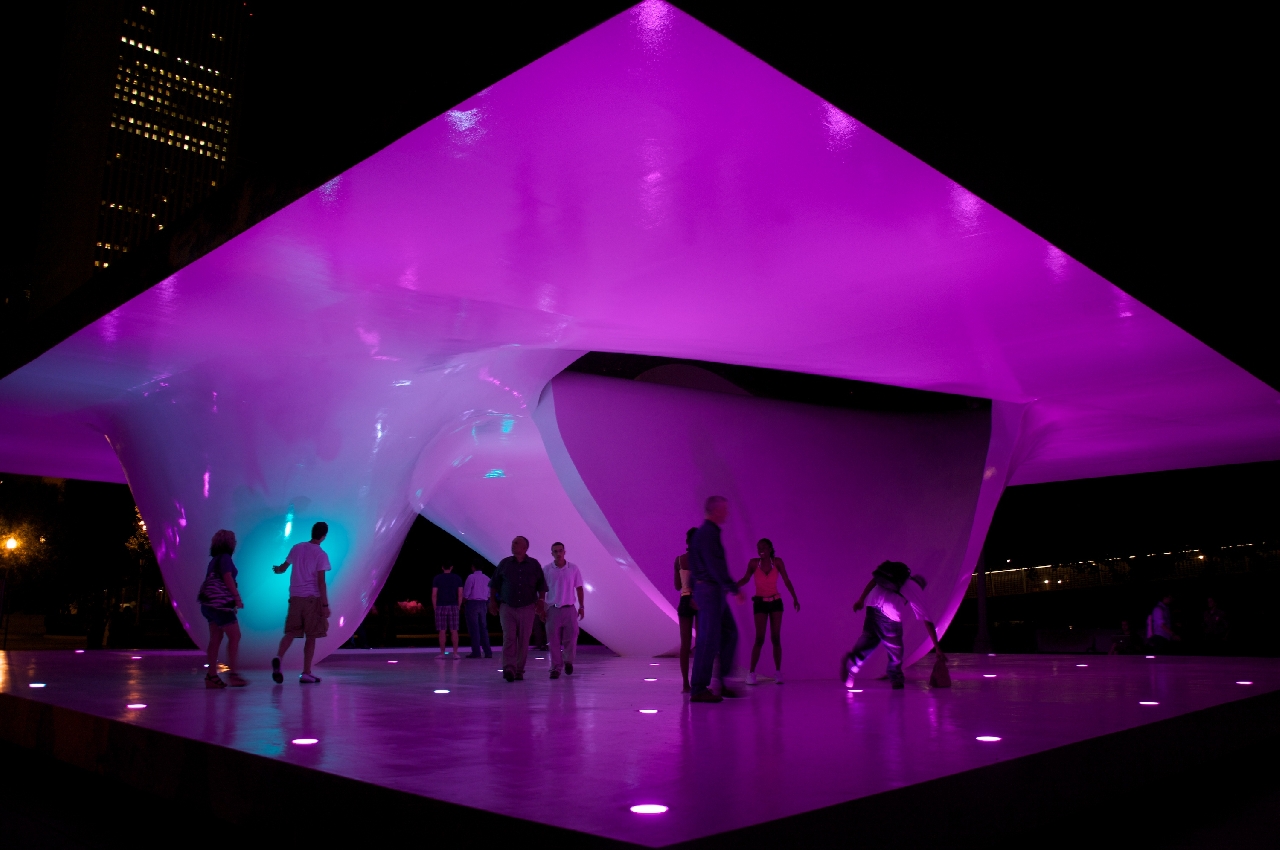
Burnham Pavilion,UNStudio and Daniel Sauter, Chicago, 2009
Phillip Beesley
Colors&Clouds,Living World,Yokohama,2004
http://www.livingworld.net/works/colors-clouds/
COLORS & CLOUDS
Minatomirai Station, Yokohama (2004)
To coincide with the opening of the Minatomirai subway line, NTT developed a media system called the Mirai Tube. Camera sensors pick up the positions of people as they move about the station concourse, and those positions are in turn expressed as visual feedback. The system was planned as a new advertising medium.
NTT commissioned four groups of artists/designers to create works using the system to be shown in the exhibition in the tube at the Minatomirai station concourse in Yokohama. Living World was one of the groups, and created two works: COLORS and CLOUDS.