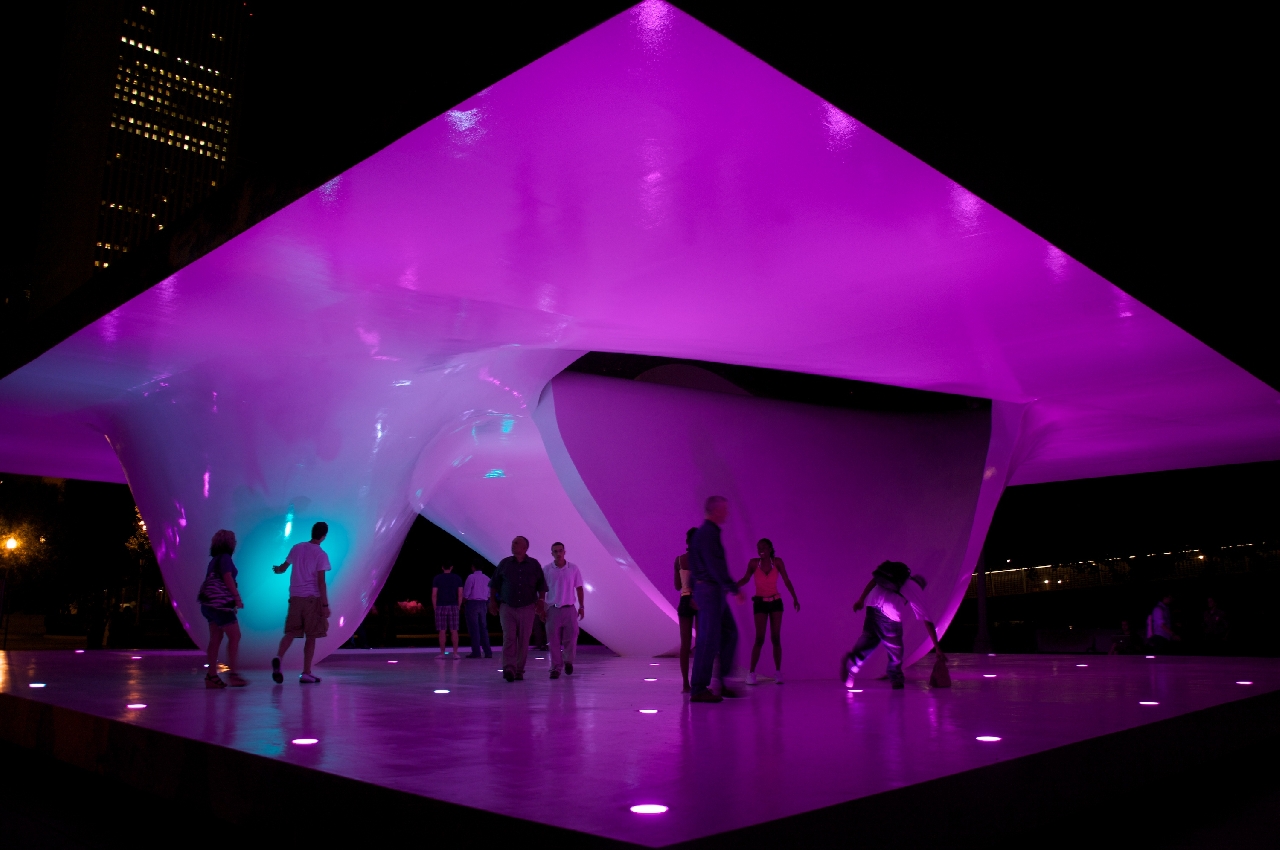
Burnham Pavilion,UNStudio and Daniel Sauter, Chicago, 2009
[Page from designer’s website]


Pulse Room in Aarhus, Denmark,2009
About 100 (analog/classic) light bulbs are hung from ceiling of the installation site.
The bulbs plays a sequence of blinking. Every singe bulb represents and actually repeats heartbeat of past participants as 1 by 1 correspondence.
Sequence of how new participant joins is as following.
One of audience grabs a handle which heartbeat sensor is embedded.
It takes a short while until the sensor stabilize its readout. When it is done, whole order of pulses of bulbs shifts 1 (the oldest is now gone). And the new beat joins.
(Aug 2011)
[from Lisson Gallery website]
Time and our perception of time as expressed through an ongoing succession of numbers lie at the heart of Tatsuo Miyajima’s practice. His sculptural work consists of networks of colored digital LED devices and integrated circuits. Miyajima calls the digital counters, the smallest units that make up the work, “gadgets”. The LEDs, placed on walls and floors, either at random or as part of structured networks, glow in the dark and convey a very specific atmosphere of silence and reflection. The numbers on the LEDs constantly change from 1 through 99 or from 1 through 9 in no specific sequential order. The endless counting of the numbers is just as important as the pauses between one flashing number and the next. Both convey a sense of temporal continuum marked by repetition and difference. Miyajima’s works can be considered the product of contemporary Japanese technology, but they also evoke a more profound philosophical proposition. According to Miyajima, the installation represents the universal concepts of “keep changing”, “connect with everything”, and “continue forever.” (Junichi Shioda, “Whither the Arts?” in Tatsuo Miyajima, MACRO, 2004, p. 135)
Tatsuo Miyajima lives and works in Ibaraki, Japan
www.tatsuomiyajima.com
Tatsuo Miyajima “Kadoya” at “house projects” at Naoshima 1998-1999
Rafael Lozano-Hemmer (born in 1967 in Mexico City) is a Mexican-Canadian electronic artist who works with ideas from architecture, technological theater and performance. He holds a Bachelors of Science in Physical Chemistry from Concordia University in Montreal. Currently, Lozano-Hemmer lives and works in Montréal and Madrid.
| Five Ws one H | |
| Who is about? | |
| What Happened? | |
| Where did it take place? |
|
| When did it take place? |
|
| Why did it happen? | |
| How did it happen? | |
nile run+を参考。走っていると、拍手のかわりに近く(前方)の照明がまたたく。
自分の前方の明かりから明るくなってゆくー>他のランナーの気配もわかるー>すれ違い時にお互いの関係性もわかる(光の色などで)
その場所にいるメンバー同士の関係を示す光の色。
広場:その地区のメンバーに表現の場を与える開かれた光
ビル:ビルのある風景を共有している人々からの建物への逆アクセス