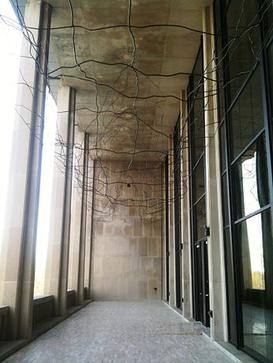
Daylight Window, Philips, (from Simplicity event at 2007)

from Philips’s Youtube Channel

The full presentation of the Philips Daylight Window concept, shown at the Simplicity Event 2007 at Earls Court in London.

(memo Sep20th2011)
around 3min, a scenario which considers light color effect for sleeping, adjusting jetlag and waking up is mentioned with some medical information/evidence such as cerotonine production.

Maya Lin

from Wikipedia

http://en.wikipedia.org/wiki/Maya_Lin

Lin, who now owns and operates Maya Lin Studio in New York City, went on to design other structures, including the Civil Rights Memorial in Montgomery, Alabama (1989) and the Wave Field at the University of Michigan (1995).[16]

In 1994, she was the subject of the Academy Award-winning documentary Maya Lin: A Strong Clear Vision. The title comes from an address she gave at Yale in which she spoke of the monument design process. Talking about the origin of her work, Lin says “My work originates from a simple desire to make people aware of their surroundings and this can include not just the physical but the psychological world that we live in”.[5]

According to Maya Lin, art should be an act of every individual willing to say something new and that which is not quite familiar.[5] When a project comes her way, she tries to “understand the definition (of the site) in a verbal before finding the form. To understand what a piece is conceptually and what its nature should be even before visiting the site”.[5]

Calleja de las Flores, Cordoba, Andalusia, Spain

From Wikipedia, the free encyclopedia

Calleja de las Flores, Great Mosque of Córdoba in the background.The Calleja de las Flores is one of the most popular and tourist streets of Córdoba city in Andalusia, Spain. Positioned as an intersection of the street Velázquez Bosco, is a narrow street that ends in a plaza

Echo Objects: The Cognitive Work of Image, Barbara Maria Stafford, 2009

Product Description
Barbara Maria Stafford is at the forefront of a growing movement that calls for the humanities to confront the brain’s material realities. In Echo Objects, she argues that humanists should seize upon the exciting neuroscientific discoveries that are illuminating the underpinnings of cultural objects. In turn, she contends, brain scientists could enrich their investigations of mental activity by incorporating phenomenological considerations—particularly the intricate ways that images focus intentional behavior and allow us to feel thought.

In the Bubble: Designing in a Complex World, John Thackara, 2006

amazon.com

Product Description

We’re filling up the world with technology and devices, but we’ve lost sight of an important question: What is this stuff for? What value does it add to our lives? So asks author John Thackara in his new book, In the Bubble: Designing for a Complex World.These are tough questions for the pushers of technology to answer. Our economic system is centered on technology, so it would be no small matter if “tech” ceased to be an end-in-itself in our daily lives.Technology is not going to go away, but the time to discuss the end it will serve is before we deploy it, not after. We need to ask what purpose will be served by the broadband communications, smart materials, wearable computing, and connected appliances that we’re unleashing upon the world. We need to ask what impact all this stuff will have on our daily lives. Who will look after it, and how?In the Bubble is about a world based less on stuff and more on people. Thackara describes a transformation that is taking place now — not in a remote science fiction future; it’s not about, as he puts it, “the schlock of the new” but about radical innovation already emerging in daily life. We are regaining respect for what people can do that technology can’t. In the Bubble describes services designed to help people carry out daily activities in new ways. Many of these services involve technology — ranging from body implants to wide-bodied jets. But objects and systems play a supporting role in a people-centered world. The design focus is on services, not things. And new principles — above all, lightness — inform the way these services are designed and used. At the heart of In the Bubble is a belief, informed by a wealth of real-world examples, that ethics and responsibility can inform design decisions without impeding social and technical innovation.

Chapter4: Locality
Chapter5: Situation